
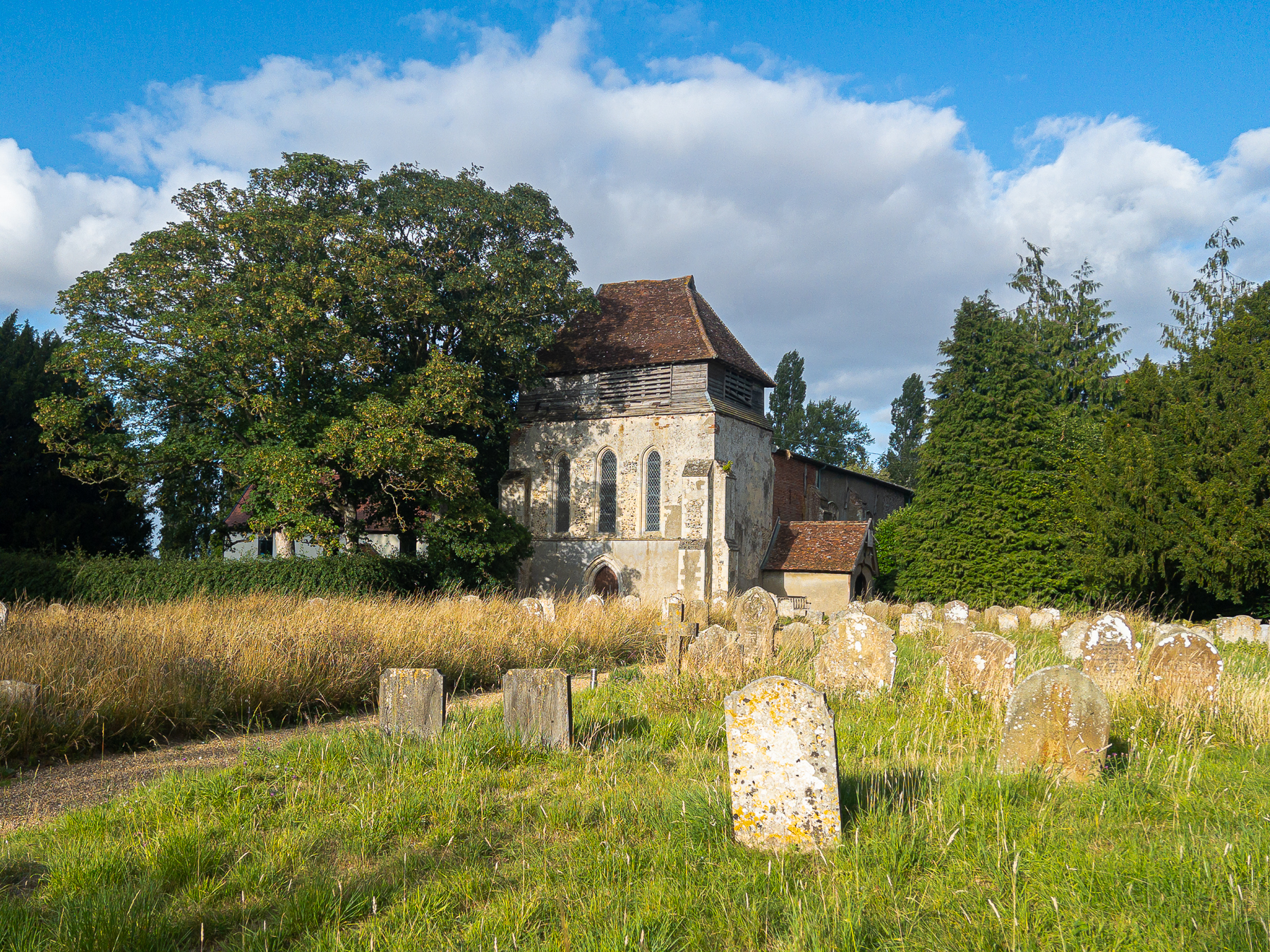
It’s been some time since my lichen recce in the Great Churchyard at St Edmundsbury Cathedral, and my survey of the Joy of All Who Sorrow Church in Mettingham, and I’ve finally had the chance to conduct another survey of a Suffolk churchyard. This past Saturday I spent an enjoyable full day recording lichens from St Michael & St Felix’s Church in Rumburgh. And I was pleased to be joined by James Rowland, a Suffolk-based ecologist keen to learn more about lichens, and who has a sharp eye for them.
St Michael & St Felix is a medieval church dating back to the 11th century, before the Norman Conquest. It was a priory for about 500 years, before it was suppressed during the English Reformation in the 16th century. The extraordinary church still has its original moat, and an unusual squat and square tower.
It also boasts a wealth of lichens. Our survey was the first since 1980, when Chris Hitch, my predecessor as County Lichen Recorder for Suffolk, recorded 49 taxa from the churchyard. For our part, James and I recorded 79 taxa, well above the average of 50 taxa for a churchyard in Suffolk, or indeed in lowland England more generally.
There’s no information in the records to indicate whether Chris was able to spend a full day on site as James and I did. It’s likely that some of the lichens we recorded from the churchyard for the first time were present in 1980 as well. Chris also recorded some species that James and I didn’t re-find, which may still be present there, too.
Indeed, I have little doubt that there are more lichen species to be found at St Michael & St Felix. A single survey rarely discovers all the species on a complex site like a churchyard, with its huge variety of substrates and aspects. And the churchyard could be even more congenial to lichens than it already is, if the trees overshadowing some of the gravestones and parts of the church walls could be pruned.
A few of the many first records that we made from the churchyard were quite special:
- Lecanora horiza: a near-threatened lichen that is easily mistaken for Lecanora campestris, and which seems when on rock to have a fairly strict preference for vertical surfaces, such as the sides of sandstone gravestones;
- Pertusaria lactescens: a locally common lichen in western Britain, but a rare species in East Anglia, recorded here for only the second or possibly third time in Suffolk;
- Verrucaria polysticta: a nationally notable lichen that can be mistaken for Placopyrenium fuscellum (Verrucaria fuscella), and which begins its life as a parasite of other Verrucaria species.
We also found some lichens that aren’t well-recorded in Suffolk, not because they’re truly scarce, but rather because they’ve been aggregated or confused with other lichens in the past. Such lichens included for instance Flavoplaca (Caloplaca) dichroa, Kuettlingeria (Caloplaca) albolutescens and Lecania inundata.
The full list of lichen and lichenicolus fungus (LF) taxa that we recorded from St Michael & St Felix is as follows:
Rumburgh : St Michael & St Felix’s Church : VC25 East Suffolk : TM3481 : 18 July 2026
- Acarospora fuscata
- Amandinea punctata
- Arthonia (Opegrapha) calcarea
- Arthonia radiata
- Athelia arachnoidea [LF]
- Bilimbia sabuletorum
- Buellia aethelea
- Buellia griseovirens
- Calogaya pusilla (Caloplaca saxicola)
- Candelariella aurella f. aurella
- Candelariella medians f. medians
- Candelariella vitellina f. vitellina
- Circinaria (Aspicilia) calcarea
- Circinaria (Aspicilia) contorta
- Circinaria (Aspicilia) hoffmanniana
- Cladonia chlorophaea s. lat.
- Diploicia canescens
- Diplotomma alboatrum
- Dirina massiliensis f. sorediata
- Flavoplaca (Caloplaca) austrocitrina
- Flavoplaca (Caloplaca) citrina s. str.
- Flavoplaca (Caloplaca) dichroa
- Flavoplaca (Caloplaca) ruderum
- Haematomma ochroleucum var. porphyrium
- Intralichen lichenicola [LF]
- Kuettlingeria (Caloplaca) albolutescens
- Lecania inundata
- Lecanora barkmaniana
- Lecanora campestris subsp. campestris
- Lecanora horiza
- Lecanora hybocarpa auct. br.
- Lecanora polytropa
- Lecanora soralifera
- Lecidella elaeochroma f. elaeochroma
- Lecidella scabra
- Lecidella stigmatea
- Lepraria finkii (lobificans)
- Lepraria incana s. str.
- Melanelixia fuliginosa
- Melanelixia glabratula
- Melanelixia subaurifera
- Muellerella lichenicola [LF]
- Myriolecis (Lecanora) albescens
- Myriolecis (Lecanora) antiqua
- Myriolecis (Lecanora) dispersa
- Myriolecis (Lecanora) semipallida
- Myriospora smaragdula
- Parmelia sulcata
- Parmotrema perlatum
- Pertusaria lactescens
- Phaeophyscia orbicularis
- Physcia adscendens
- Physcia caesia
- Physcia tenella
- Physconia enteroxantha
- Physconia grisea
- Polyblastia dermatodes
- Porpidia tuberculosa
- Protoblastenia rupestris
- Protoparmeliopsis (Lecanora) muralis
- Psilolechia lucida
- Punctelia subrudecta s. str.
- Pyrrhospora quernea
- Rinodina oleae
- Tephromela atra var. atra
- Trapelia obtegens
- Variospora (Caloplaca) flavescens
- Verrucaria macrostoma f. furfuracea
- Verrucaria macrostoma f. macrostoma
- Verrucaria muralis
- Verrucaria nigrescens f. nigrescens
- Verrucaria polysticta
- Verrucaria viridula
- Xanthoparmelia mougeotii
- Xanthoria calcicola
- Xanthoria parietina
- Zeora (Lecanora) expallens
- Zeora (Lecanora) orosthea
- Zeora (Lecanora) sulphurea
