
| TAXON: | Xanthoria parietina (L.) Th. Fr. (1860) |
| RECENT SYNONYMS: | – |
| FAMILY: | Teloschistaceae |
| GROWTH FORM: | Foliose, heteromerous |
| SUBSTRATES: | Broad variety of natural and artificial nutrient-enriched substrates |
| PHOTOBIONT: | Trebouxioid alga |
| REPRODUCTION: | Apothecia, pycnidia |
| ASCUS: | Clavate; apex Teloschistes-type; 8 spores |
| SPORES: | Ascospores ellipsoidal, polarilocular, (10)-12-16 × (6)-7-9 µm; conidia ellipsoidal |
| NOTABLE FEATURES: | Thallus yellow to yellow-orange, but yellow-green when wet and sometimes grey-green in shade, often spreading and extensive, attached to substrate by hapters; lobes broad, overlapping and almost ‘flouncy’, sometimes appearing as small lobules at thallus centre; apothecia lecanorine, abundant, somewhat stalked, urn-like when young; discs orange |
| CHEMICAL TESTS: | Thallus K+ crimson-purple, UV+ red (parietin) |
| HABITAT: | Wherever suitably nutrient-enriched substrate available, including urban areas; restricted to naturally nutrient-enriched substrate in clean-air areas |
| DISTRIBUTION: | Widespread and common in Britain |
| CONSERVATION STATUS: | Least Concern |
| LICHENICOLOUS FUNGI: | Arthonia parietinarium, Athelia arachnoidea, Burgoa moriformis, Cladosporium licheniphilum, Didymocyrtis epiphyscia sens. lat., D. slaptoniensis, Epithamnolia xanthoriae, Erythricium aurantiacum, Gonatophragmium lichenophilum, Illosporiopsis christiansenii, Laetisaria lichenicola, Lichenoconium xanthoriae, Lichenodiplis poeltii, Marchandiomyces corallinus, Monodictys fuliginosa, Nectriopsis indigens, N. physciicola, Phacothecium varium, Pronectria xanthoriae, Pyrenochaeta xanthoriae, Sphaerellothecium parietinarium, Taeniolella scripta, Telogalla olivieri, Tremella occultixanthoriae, T. parietinae, Xanthoriicola physciae, Zwackhiomyces coepulonus |
| IDENTIFICATION DIFFICULTY: | Green 1: Field identification possible |
| CONFUSION SPECIES: | Xanthoria aureola |
FIELD NOTES
To be added.
LAB NOTES
Xanthoria parietina can be identified without microscopy.
SPECIMENS
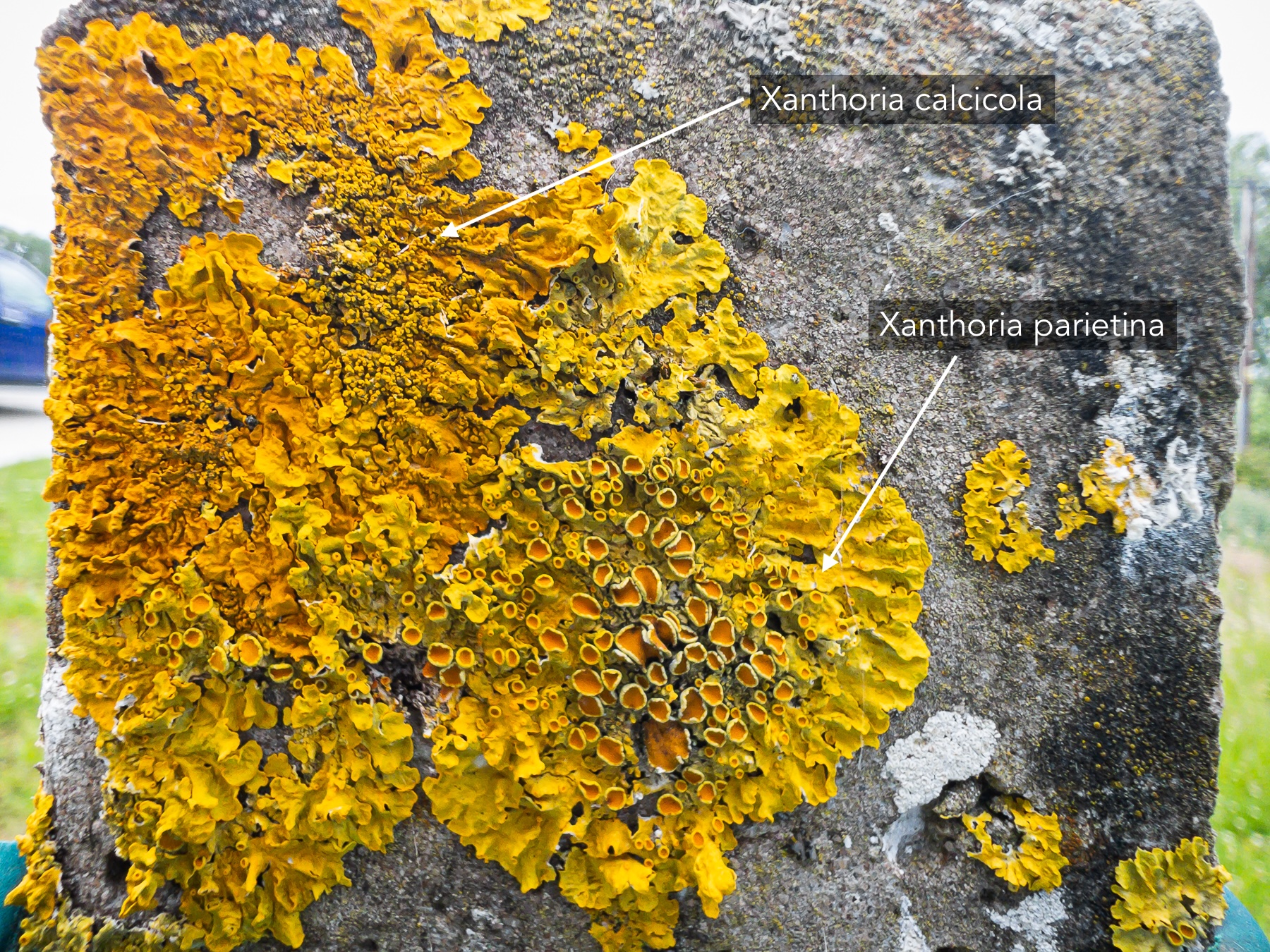
Xanthoria parietina : England : VC25 East Suffolk : TM3787 : June 2026 : On concrete fence-post : © Anthony Speca : CC BY-SA 4.0

Xanthoria parietina : England : VC19 North Essex : TM0214 : September 2025 : On painted metal street-sign : © Anthony Speca : CC BY-SA 4.0


Xanthoria parietina : England : VC25 East Suffolk : TM2535 : May 2025 : On Suaeda stem : © Anthony Speca : CC BY-SA 4.0

Xanthoria parietina : England : VC20 Hertfordshire : TL3510 : March 2025 : On wooden bench : © Anthony Speca : CC BY-SA 4.0

Xanthoria parietina : England : VC25 East Suffolk : TM3389 : July 2024 : On painted metal car chassis and synthetic rubber seal : © Anthony Speca : CC BY-SA 4.0

Xanthoria parietina : England : VC27 East Norfolk : TG0245 : March 2024 : On siliceous pebble : © Anthony Speca : CC BY-SA 4.0


Xanthoria parietina : England : VC27 East Norfolk : TG0245 : March 2024 : On Calluna stem : © Anthony Speca : CC BY-SA 4.0

Xanthoria parietina : England : VC27 East Norfolk : TG0340 : October 2023 : On Sorbus twig : © Anthony Speca : CC BY-SA 4.0

Xanthoria parietina : Scotland : VC101 Kintyre : NR6974 : August 2023 : On siliceous outcrop : © Anthony Speca : CC BY-SA 4.0

Xanthoria parietina : England : VC25 East Suffolk : TM3381 : March 2023 : On concrete fence-post : © Anthony Speca : CC BY-SA 4.0

Xanthoria parietina : England : VC25 East Suffolk : TM3389 : March 2023 : On Tilia twig : © Anthony Speca : CC BY-SA 4.0

Xanthoria parietina : England : VC25 East Suffolk : TM4076 : March 2023 : On Crategus twig : © Anthony Speca : CC BY-SA 4.0


Xanthoria parietina : England : VC25 East Suffolk : TM4076 : February 2023 : On Crategus twig : © Anthony Speca : CC BY-SA 4.0

Xanthoria parietina : England : VC25 East Suffolk : TM4076 : December 2022 : On unknown bark : © Anthony Speca : CC BY-SA 4.0


Xanthoria parietina : England : VC25 East Suffolk : TM4076 : November 2022 : On Crategus twig : © Anthony Speca : CC BY-SA 4.0

Xanthoria parietina : England : VC27 East Norfolk : TG0243 : October 2022 : On Quercus trunk : © Anthony Speca : CC BY-SA 4.0


Xanthoria parietina : England : VC25 East Suffolk : TM4057 : August 2022 : On unknown bark : © Anthony Speca : CC BY-SA 4.0

Xanthoria parietina : Scotland : VC101 Kintyre : NR7786 : August 2022 : On siliceous cobble : © Anthony Speca : CC BY-SA 4.0


Xanthoria parietina : Scotland : VC101 Kintyre : NR6974 : July 2022 : On siliceous outcrop : © Anthony Speca : CC BY-SA 4.0


Xanthoria parietina : England : VC25 East Suffolk : TM5075 : July 2022 : On unknown bark : © Anthony Speca : CC BY-SA 4.0

