
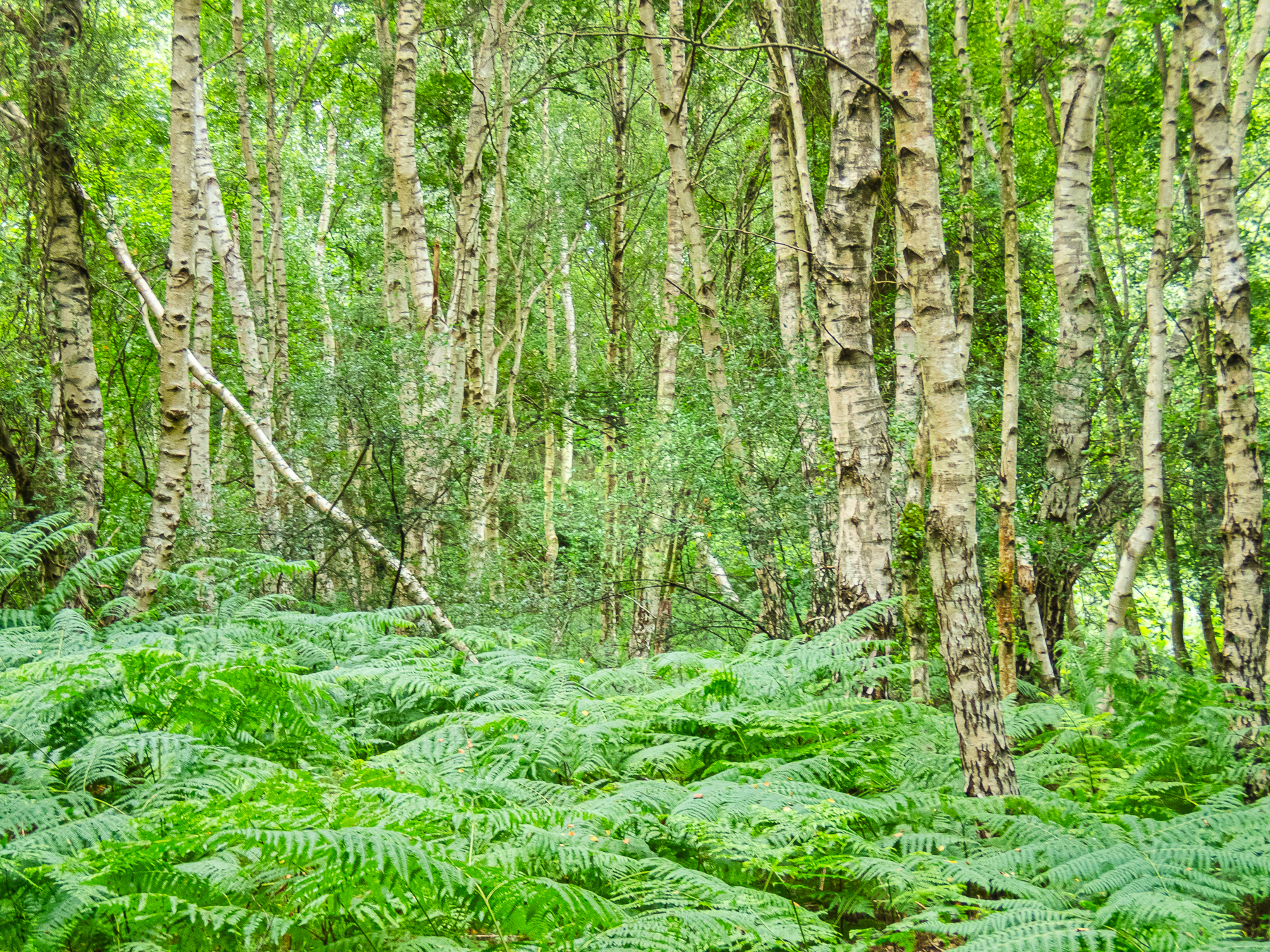
Last weekend I spent a little time informally recording lichens in Rendlesham Forest, while on a short break there with my family. The Forestry Commission, now Forestry England, created Rendlesham Forest shortly after the First World War, at a time when timber had become scarce. Today, it’s still mainly a conifer plantation managed for timber, but some parts are managed for wildlife, and other trees such as the birches above have been allowed to colonise it.
Sadly, Rendlesham Forest was planted on the Suffolk Sandlings, an internationally rare habitat of lowland heath. At the time, the sandy and nutrient-poor heathland soil was considered ‘waste ground’, good for little more than grazing sheep, hunting rabbits or cutting fodder. It was thought better either to ‘improve’ the soil with muck and other fertilisers so that it could be farmed, or to plant it with fast-growing, sand-loving pine trees so that it would yield timber.
The Sandlings once stretched the length of East Suffolk, from Kessingland in the north to Woodbridge in the south. Now only about eight percent of the heathland remains, mainly in small and fragmented parcels. Many of its specialised plants and animals have become scarce or rare, including birds such as the nightjar, and butterflies such as the silver-studded blue.
Britain hosts about 20 percent of the world’s remaining lowland heath. Suffolk hosts about five percent of Britain’s share, with what is left of the Sandlings accounting for about half of that. Restoring Sandlings habitat, and linking up the parcels that remain, is one of the most important conservation priorities for Suffolk, and indeed for Britain as a whole.
The loss of lowland heath in Britain has also meant the loss of specialised heathland lichen communities. These ground-dwelling communities are dominated by attractive Cladonia species, such as the ‘pixie cups’ that appear in many illustrated fairy-tale books. And because lichens are unable to compete with vascular plants on ‘improved’ soil, the abundance and diversity of heathland lichens tells you just how healthy your heath is — not only for the lichens themselves, but also for all the other specialised heathland plants and animals.
I was glad, then, to find ten different species of Cladonia on an amble along the ‘Phoenix Trail’ through Rendlesham Forest. They weren’t growing in the closed woodland, of course! Rather, I found them in very small patches of heathland or acid grassland that still remain, whether just along the side of a forestry track, or in habitat that Forestry England has created by felling trees without replanting them.
A heathland can boast at least 20 species of such lichens is considered nationally significant and worthy of legal protection. A heathland with at least ten species is considered significant at the county level. Rendlesham Forest may be a woodland, not a heathland. But the presence of ten Cladonia species in little patches in the woods signals that the rare and vital lowland heath of the Sandlings still survives somewhere under all those trees.
The full list of taxa I recorded from Rendlesham Forest, including both lichens on trees as well as on the ground, is as follows:
Tengham : Rendlesham Forest (campsite and Phoenix Trail) : VC25 East Suffolk : TM3547, TM3548 & TM4547 : 4 July 2026
- Alyxoria culmigena
- Amandinea punctata
- Arthonia radiata
- Candelariella xanthostigmoides
- Cliostomum griffithii
- Cladonia ciliata var. tenuis
- Cladonia chlorophaea s. lat.
- Cladonia coniocraea
- Cladonia furcata subsp. furcata
- Cladonia humilis
- Cladonia polydactyla
- Cladonia portentosa
- Cladonia ramulosa
- Cladonia rangiformis
- Cladonia scabriuscula
- Cladonia subulata
- Evernia prunastri
- Glaucomaria (Lecanora) carpinea
- Hyperphyscia adglutinata
- Hypotrachyna revoluta s. str.
- Lecanora hybocarpa auct. br.
- Lecidella elaeochroma f. elaeochroma
- Lepraria incana s. str.
- Parmelia sulcata
- Peltigera hymenina
- Phaeophyscia orbicularis
- Physcia adscendens
- Punctelia subrudecta s. str.
- Ramalina farinacea
- Ramalina fastigiata
- Rhizocarpon reductum
- Xanthoria parietina
- Zeora (Lecanora) expallens
- Zeora (Lecanora) symmicta
