
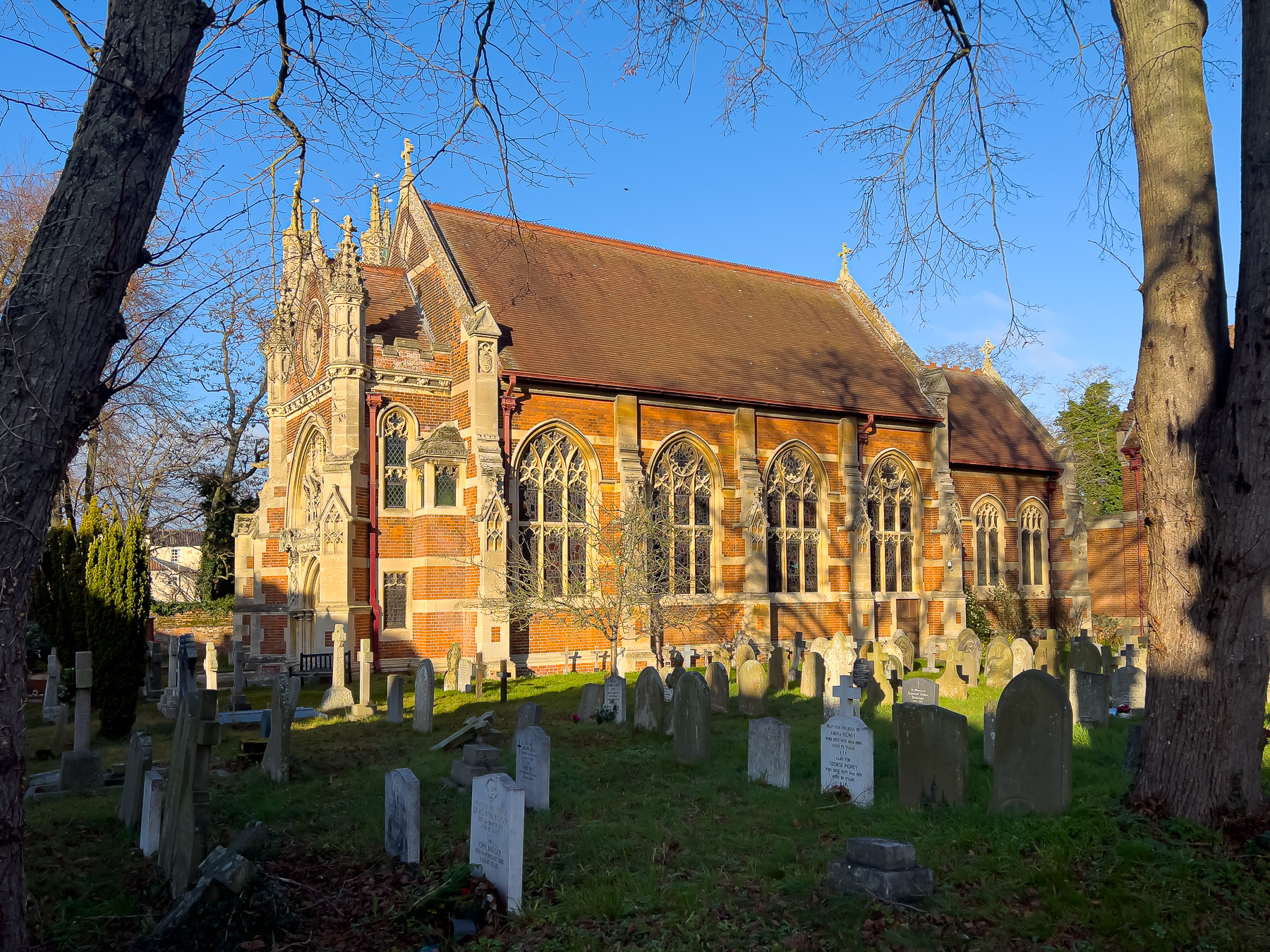
After spending New Year’s Eve mapping unsurveyed Suffolk churchyards, I ventured out to survey one: St Edmund’s Church in Bungay. St Edmund’s is an ornate and beautiful late-Victorian Roman Catholic church, with a stunning baptistry that ‘field ecclesiologist’ Simon Knott calls ‘the most significant Art Nouveau space in Suffolk’. It replaced a smaller Roman Catholic chapel built in 1823.
A leisurely day of surveying turned up about three dozen lichen species. This figure is a bit short of the 50 species for the average Suffolk church. But compared to Suffolk’s many medieval churches, St Edmund’s is young, and its town-centre churchyard is fairly small. And St Edmund’s did offer a few species of local interest:
- Alyxoria ochrocheila — on a Prunus trunk, the first record for Bungay and the wider TM38 hectad
- Athallia holocarpa s. str. — on a sandstone headstone, the first record for Bungay and the wider TM38 hectad (though the A. holocarpa s. lat. species aggregate had been recorded previously)
- Bagliettoa calciseda — on a limestone headstone, the first record for Bungay and the wider TM38 hectad, and a ‘nationally scarce’ species (but really just under-recorded)
- Flavoplaca dichroa — a ‘nationally scarce’ species (but really just under-recorded).
The full list of species recorded from St Edmund’s Church is as follows:
Bungay : St Edmund’s Church : VC25 East Suffolk : TM3389 : 2 January 2026
- Acarospora fuscata
- Alyxoria (Opegrapha) ochrocheila
- Amandinea punctata
- Arthonia radiata
- Athallia (Caloplaca) holocarpa s. str.
- Bagliettoa (Verrucaria) calciseda
- Bagliettoa parmigera s. lat. (Verrucaria baldensis s. lat.)
- Botryolepraria lesdainii
- Buellia aethalea
- Candelariella aurella f. aurella
- Candelariella vitellina f. vitellina
- Circinaria (Aspicilia) calcarea
- Diploicia canescens
- Diplotomma alboatrum
- Flavoplaca (Caloplaca) citrina s. str.
- Flavoplaca (Caloplaca) dichroa
- Flavoplaca (Caloplaca) flavocitrina
- Lecanora campestris subsp. campestris
- Lecanora expallens
- Lecanora polytropa
- Lecanora soralifera
- Lecidella elaeochroma f. elaeochroma
- Lecidella scabra
- Lepraria incana s. str.
- Myriolecis (Lecanora) albescens
- Physcia adscendens
- Porpidia tuberculosa
- Protoblastenia rupestris
- Psilolechia lucida
- Rhizocarpon reductum
- Variospora (Caloplaca) flavescens
- Verrucaria macrostoma f. macrostoma
- Verrucaria nigrescens f. nigrescens
- Xanthoria parietina

