
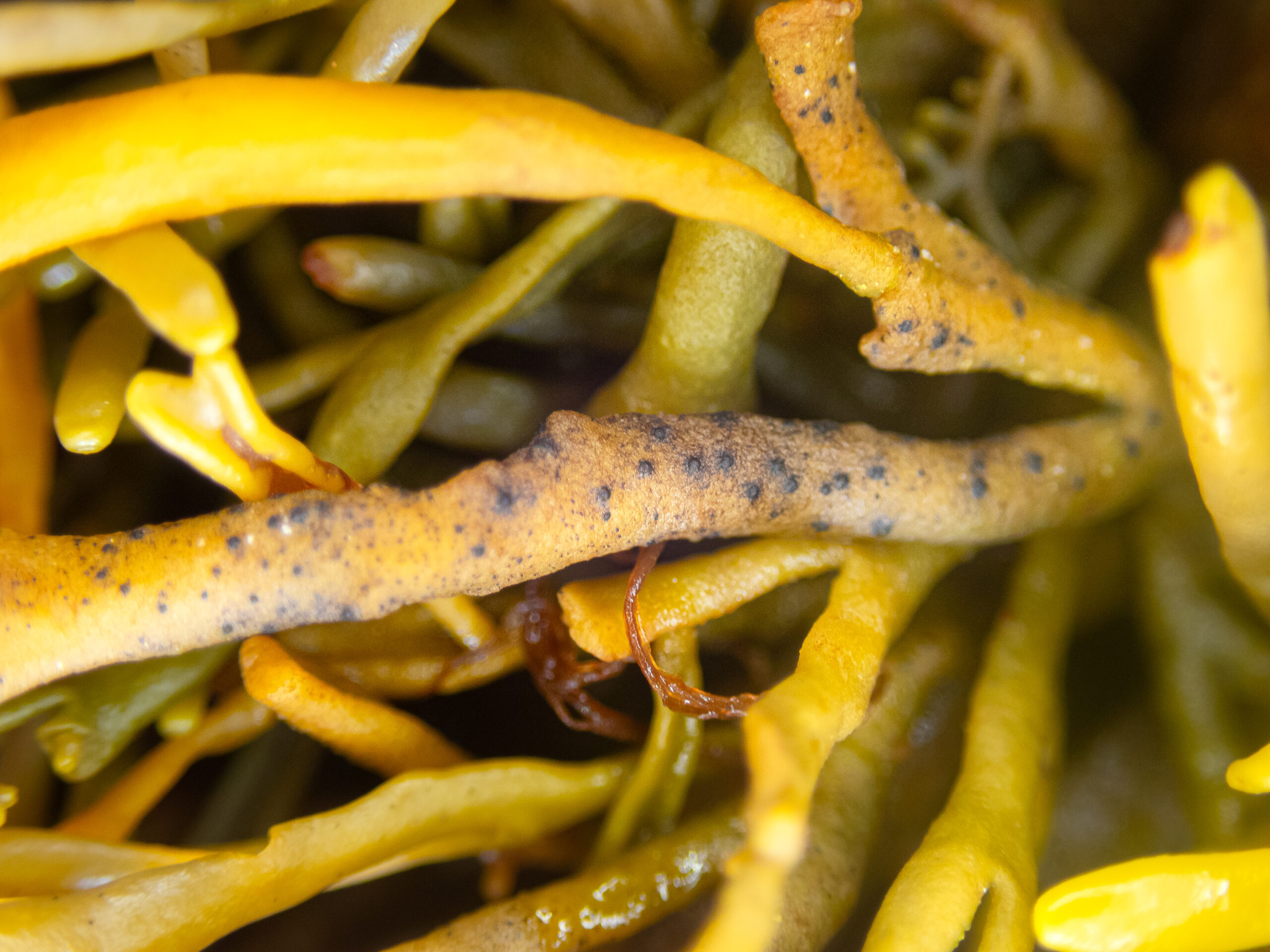
While on a family holiday on the western shore of Scotland this month, I sought out an extraordinarily unusual lichen.
Most lichens are partnerships of fungi and algae. The fungus provides the defensible bodily structure within which the alga lives. The alga provides the nourishment for the entire partnership through photosynthesis. Some lichens are partnerships between fungi and photosynthetic cyanobacteria, and some involve all three, but the basic principle is the same.
My unusual lichen turns some of that partnership on its head. Collemopsidium pelvetiae involves fungal and a cyanobacterial partners in the usual way, but it lives on and mostly in a third algal partner. That partner is the common British seaweed Pelvetia canaliculata, or channelled wrack. For what is a seaweed but giant, organised algae!
C. pelvetiae is designated as ‘nationally rare’ in Britain. This designation is somewhat technical, as it only means that the lichen has been recorded from 15 or fewer hectads (10-km grid squares) in the whole country. In fact, data about the distribution of C. pelvetiae in Britain is just deficient. Who spends a sunny visit to the beach turning over seaweed to look for lichens, even if they’re a lichenologist?
I had a suspicion that C. pelvetiae is much more common than data would suggest. After all, channelled wrack is common on rocky shores all around Britain, and C. pelvetiae would have the advantage of marine currents to distribute its spores. And my first find of C. pelvetiae, on a rocky shore on Anglesey in Wales, was much easier than I expected. A few short minutes checking a sward of channelled wrack was all it required.
Inspired to search for more C. pelvetiae, I took the opportunity to examine channelled wrack on almost every beach we visited while on holiday. The lichen grows only on the fronds of the seaweed, not the fertile receptacles at the ends of the fronds — which are sometimes home to an unrelated and non-lichenised fungus called Mycophyscias ascophylli — so some poking around was usually necessary.
But as I suspected, C. pelvetiae was easy enough to find, and it was present on channelled wrack on three of six beaches visited. I don’t yet know how to explain its absence on the other three beaches, but perhaps I just missed it.
A few data points from north Anglesey and west Inverness-shire don’t make a provable trend. But my suspicion that C. pelvetiae is fairly common on British rocky shores has certainly strengthened. If you find it near you, get in touch!
