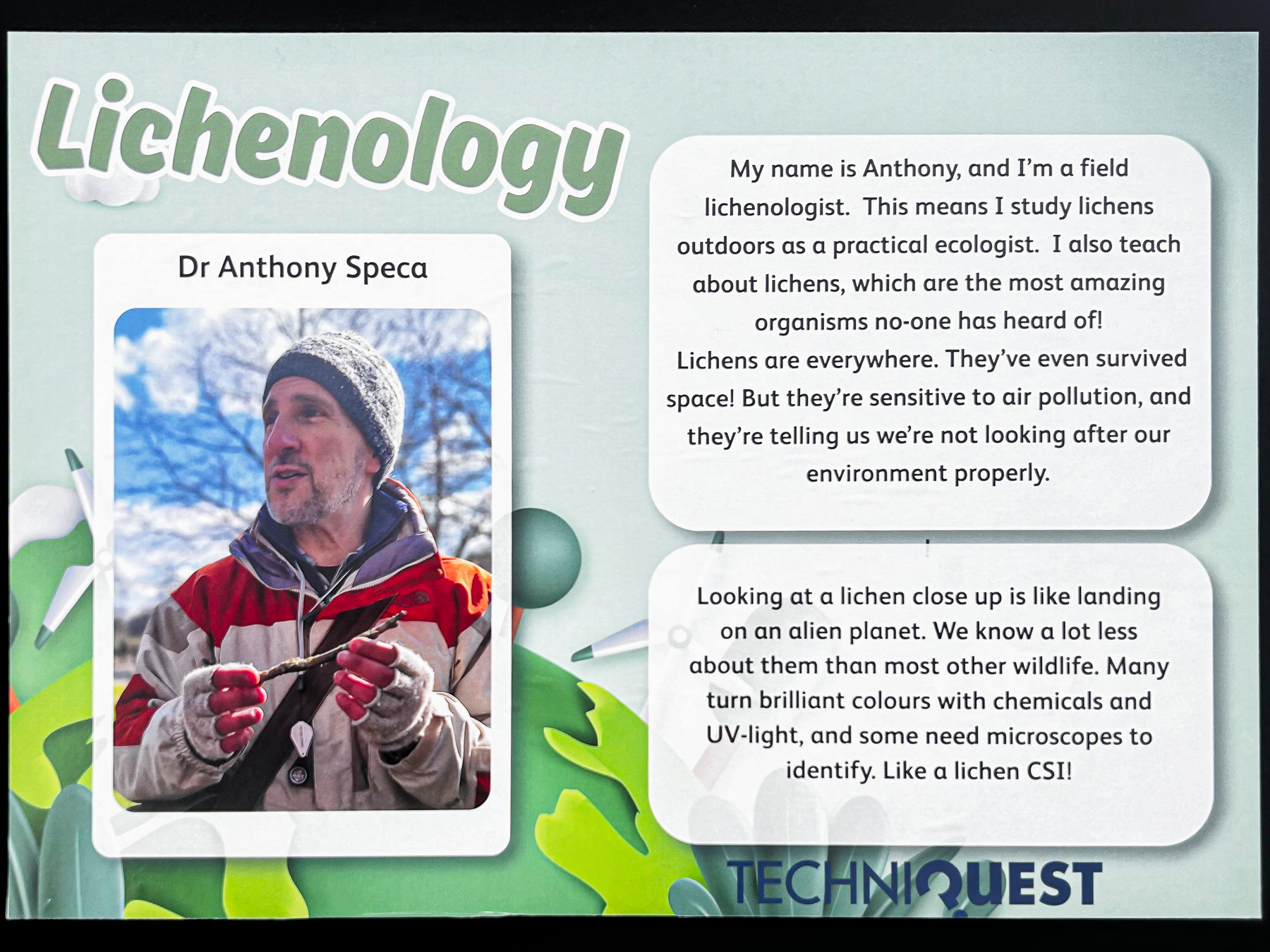
Featured in Techniquest careers exhibit

Image courtesy of Kim Sellwood/Techniquest

I’m grateful to Kim Sellwood of the Techniquest Science Discovery Centre in Cardiff for featuring lichenology in their current environmental careers exhibit, and for asking me to be the face of lichenology for their youth audience!

Techniquest is the UK’s oldest purpose-built science learning centre, established in 1986. It’s dedicated to youth of school age, and to inspiring them about STEM: science, technology, engineering and mathematics.

Their current exhibit highlighting ecological and environmental careers runs all through June, and it forms part of a wider project to engage youth with environmental topics. I’m proud to be involved in it.

Lichenology: Dr Anthony Speca

My name is Anthony, and I’m a field lichenologist. This means I study lichens outdoors as a practical ecologist. I also teach about lichens, which are the most amazing organisms no-one has heard of!

Lichens are everywhere. They’ve even survived space! But they’re sensitive to air pollution, and they’re telling us we’re not looking after our environment properly.

Looking at a lichen close-up is like landing on an alien planet. We know a lot less about them than most other wildlife. Many turn brilliant colours with chemicals and UV-light, and some need microscopes to identify. Like a lichen CSI!

Anthony is the field lichenologist behind Aspen Ecology. A committed naturalist, educator and communicator, he is a knowledgeable guide and responsive advisor on the remarkable world of lichens.

About Anthony and Aspen Ecology >

EXPLORE CATEGORIES

EXPLORE TAGS

EXPLORE LINKS

These websites include valuable online libraries of lichen images, species descriptions or both:

LICHEN ETHICS AND SAFETY

The field notes and lab notes for various lichen species on this website refer to special field-lichenological techniques. Examples include collecting lichens in the field, testing lichens with chemicals and ultraviolet light, and dissecting lichens with razors or other sharp tools.

These and other field-lichenological techniques require special knowledge and experience. They also demand an ethics of respect for lichens and other wildlife, for conservationally significant species and sites, and for land and landowners.

You should not attempt any of these techniques if you lack the necessary knowledge, experience or ethical sense. You should also take all relevant safety precautions. More information about field-lichenological safety and ethics is available from the British Lichen Society .