
The seriously polluted state of many of Britain’s rivers has been much in the news. It’s by now well known that a significant share of this pollution is due to poor sewage management by water companies. Perhaps somewhat less popular attention is paid to agricultural runoff as a source of river pollution, especially where livestock is grazed, or slurry (a mix of animal manure and urine) is spread on fields as a fertiliser.
A considerable amount of slurry spread on fields originates as a by-product of intensive livestock farming, particularly pig and poultry farming. In Suffolk where I live, there are many such intensive farms. Indeed, according to the Department for Environment, Food & Rural Affairs, the East of England accounts for a full quarter of all pigs and poultry in England. Most of those pigs and birds are concentrated in Norfolk and Suffolk.
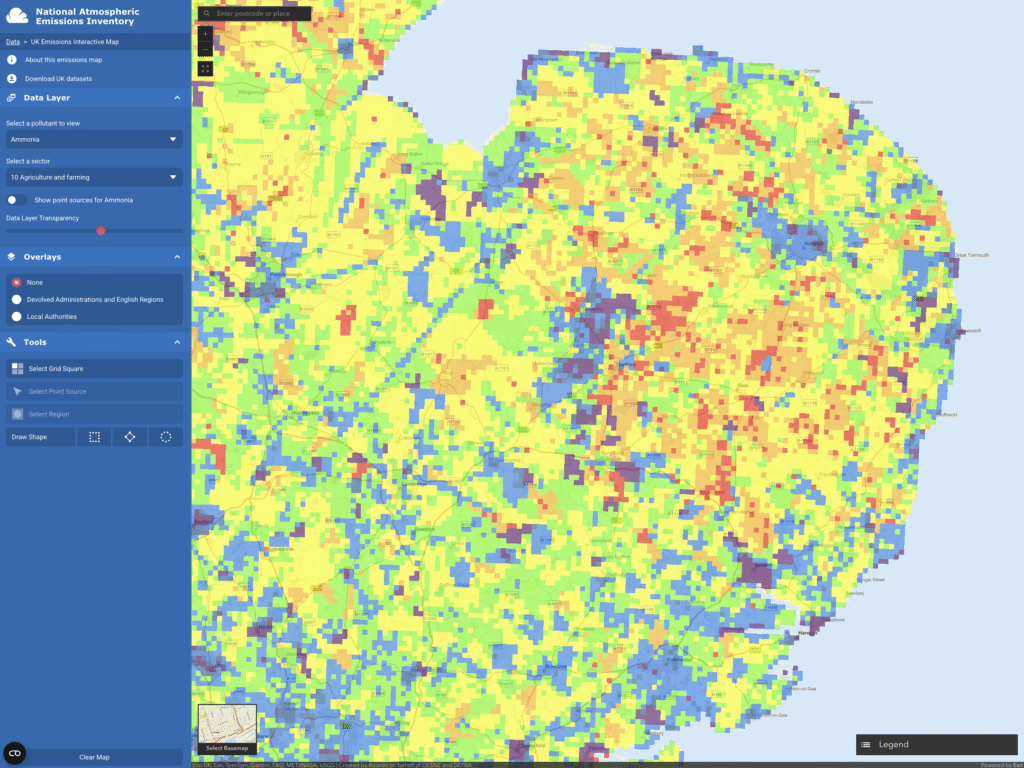
Some of the slurry spread on Suffolk fields washes into rivers and pollutes them. But it’s less well-known that it pollutes the air as well. The air-pollution takes the form of ammonia (NH3), a gas that escapes from the slurry and eventually settles on any exposed surface, both on its own and mixed with rain. The map above shows the high levels of ammonia pollution in East Anglia today.
As a field lichenologist, I’m very concerned by ammonia pollution. Lichens are largely open to the air and rain with which they come into contact. They readily absorb pollutants in a more-or-less uncontrolled manner. This openness makes lichens excellent biological indicators of pollution, but it also harms them if they’re unable to deal with the pollution they take in.
In general, lichens are astonishingly resilient. But ammonia pollution presents a special problem for them, because the nitrogen element in ammonia interferes with photosynthesis. Lichens depend entirely on photosynthesis for their food, and many lichen species are unable to manage nitrogen exposure well. In a place such as Suffolk, with high background levels of ammonia pollution, they starve and die.
This isn’t to say that lichens can’t live in Suffolk. For a lichen, a tree is a planet and a forest a galaxy. In the tiny micro-habitats where lichens live, some spots are better shielded from ammonia than others. And some lichen species not only handle the nitrogen in ammonia well, they positively thrive on it.
But it is to say that the Suffolk’s lichen flora is warped. Thanks to the high levels of ammonia pollution in Suffolk, our lichen flora is dominated by nitrogen-loving and nitrogen-tolerant species, with nitrogen-sensitive species confined to more protected clean-air locations, such as the middle parts of our few ancient woods. And the more intensively pigs and poultry are farmed here, the more warped Suffolk’s lichen flora becomes.
This is why I was pleased to be asked by investigative journalist Tracy Keeling to comment on ammonia and lichens for her article about intensive poultry farming in Suffolk. Published yesterday by The Bureau of Investigative Journalism, Tracy’s article begins with local discontent at the prospect of a new ‘chicken megafarm’ near a Suffolk village. But she goes on to consider the wider threat that slurry from such farms poses not only to rivers, but also the air — and with the air, lichens.
Ammonia pollution is taken into human lungs, too, as anyone from Suffolk who has smelt the tang of slurry being spread on fields around their village or town can tell you. It has implications for human health, as well as for the health of lichens. So Tracy’s article is well worth a full read.
But as Aspen Ecology is devoted to lichens, I hope Tracy won’t mind if I quote here that small part of her article in which lichens feature:
Harmful airborne particles can be created when ammonia mixes with other gases, which is a human health hazard. Ammonia can also harm biodiversity, particularly lifeforms like lichens. These colourful splodges found on tree branches and other outdoor surfaces are ecologically important, capturing carbon, sheltering invertebrates and serving as food or nest materials for animals, said field lichenologist Anthony Speca.
Lichens are “incredibly resilient”, he added. Some of them even survived being attached to the outside of the International Space Station. But nitrogen is “kryptonite” to many lichens, so their diversity in ammonia-polluted areas diminishes, leaving only nitrogen-tolerant ones behind.
Speca said they offer proof that our ecosystems are heading in the wrong direction: “Lichens are your canaries in the coal mine.”
