
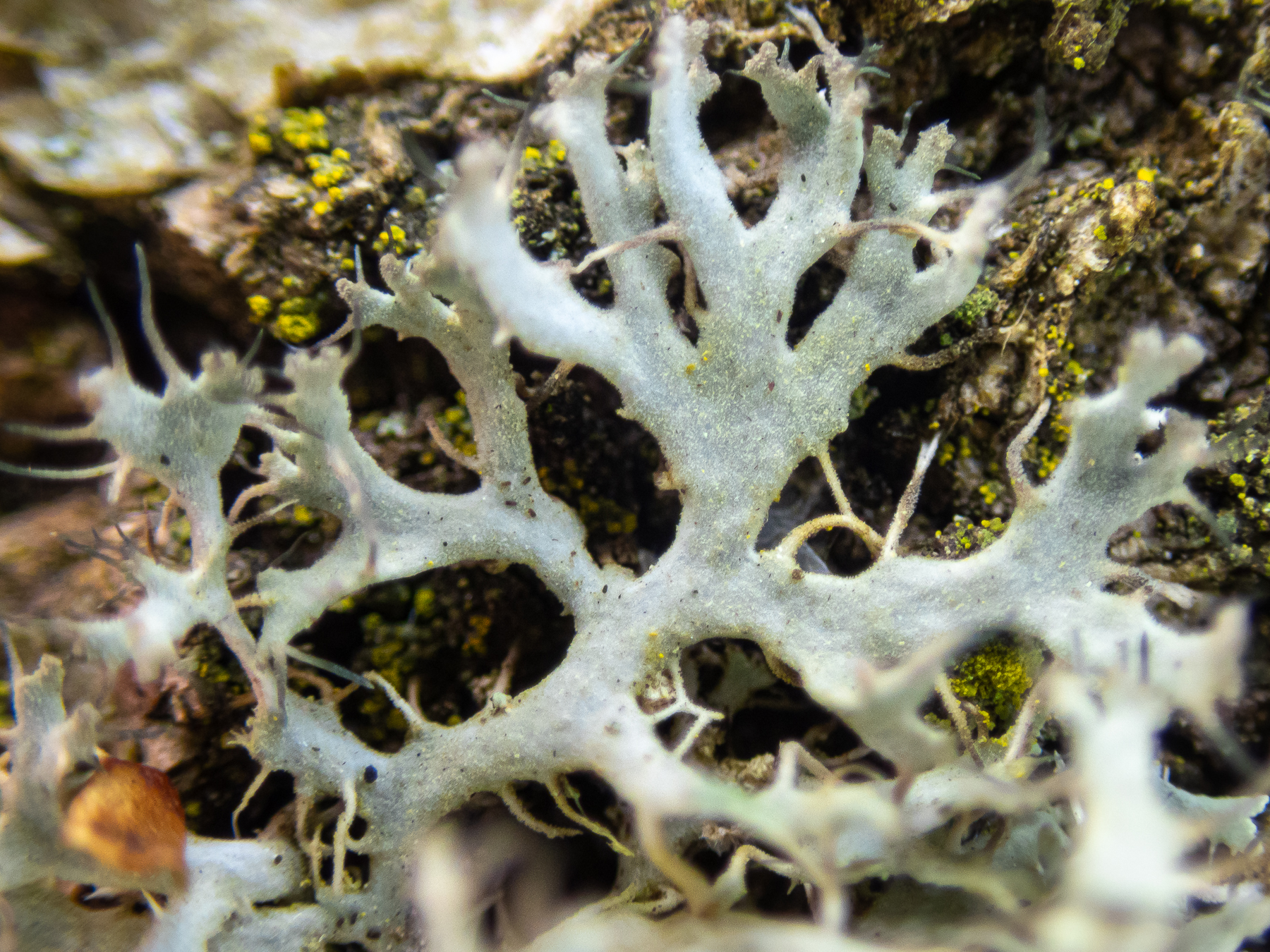
Two weekends ago, I was astonished to find Anaptychia ciliaris on an oak tree during a half-day survey of Holton Pits, a County Wildlife Site and Site of Special Scientific Interest (SSSI) near Holton in Suffolk.
A. ciliaris is an endangered lichen in Britain. It was once widespread, especially in lowland England, but it has been in free-fall since at least the 1950s. Between 50 and 80 percent of its population has disappeared, and probably at the higher end of that range.
A. ciliaris has faced a perfect storm of environmental pressures. It is typically a lichen of high tree branches and trunks, or more unusually of unshaded stone walls or gravestones, where it can get the strong light on which it thrives. But it prefers the basic bark of elm and ash trees, which have themselves suffered from Dutch elm disease and ash dieback.
More than that, A. ciliaris is sensitive to air pollution. Formerly, it was harmed by sulphur pollution, mainly from burning coal for electricity. Latterly, it has been harmed by nitrogen pollution, mainly from agricultural activities.
The combination of toxic pollution and the loss of its preferred trees has put A. ciliaris in serious danger of extinction in Britain. Indeed, until my recent find, it was thought to have gone extinct in Suffolk. It was last recorded in the county at Sotterley Park in 1985, where it has not yet been re-found despite more recent visits from the British Lichen Society.
The environmental pressures that A. ciliaris faces have not abated, and the lichen is still in decline in England. It’s clinging on in parklands and pastures mainly from Dorset to the Cotswolds, and in a small population on drystone walls in Yorkshire. My find in Suffolk is unusual good news for this species.
It is unclear how long A. ciliaris has been present in Holton Pits. The site had not been surveyed for lichens before my visit. What is clear is that this lichen is the only known specimen not only in Suffolk or in East Anglia, but in virtually the whole of the East of England. A specimen recorded in 2012 on sycamore at Houghton Park in Norfolk has since been lost, and a specimen last seen in 2022 on a gravestone in Bedfordshire seems to be unhealthy, and may now be gone.
This makes the oak tree on which I found it one of the most important oaks in all of Suffolk! Sadly, the oak is overshadowed by a tall pine, which is forcing it to grow out only on two sides. The lichen is growing on a relatively low branch, so it’s also threatened with scraping or shading from a hazel sapling and climbing bramble.
The only A. ciliaris known in virtually all of the East of England deserves the best possible chance. Since my find, I’ve had the opportunity to meet with the trustees of the community interest company that owns Holton Pits on behalf of local people. Properly protected and managed, the oak and lichen will very likely live much longer than the pine above, as well as the hazel and bramble beneath.
I’ve recommended that the trustees design a specific management plan for the oak, which should likely include removing the overshadowing pine. The pine is a non-native, plantation forestry species that arguably doesn’t belong in a SSSI in any case, and certainly not when it threatens to shade or topple over on a seriously endangered lichen. Natural England also has a role to play in helping the trustees to conserve A. ciliaris, since they have special responsibility to support proper management of SSSIs. I’ve already alerted the regional team.
Finally, I’ve recommended to the trustees that they commission a targeted survey of the site to ascertain if any further specimens of A. ciliaris can be found. It was the last thing I expected to find that day, and who knows what else might be there!
