
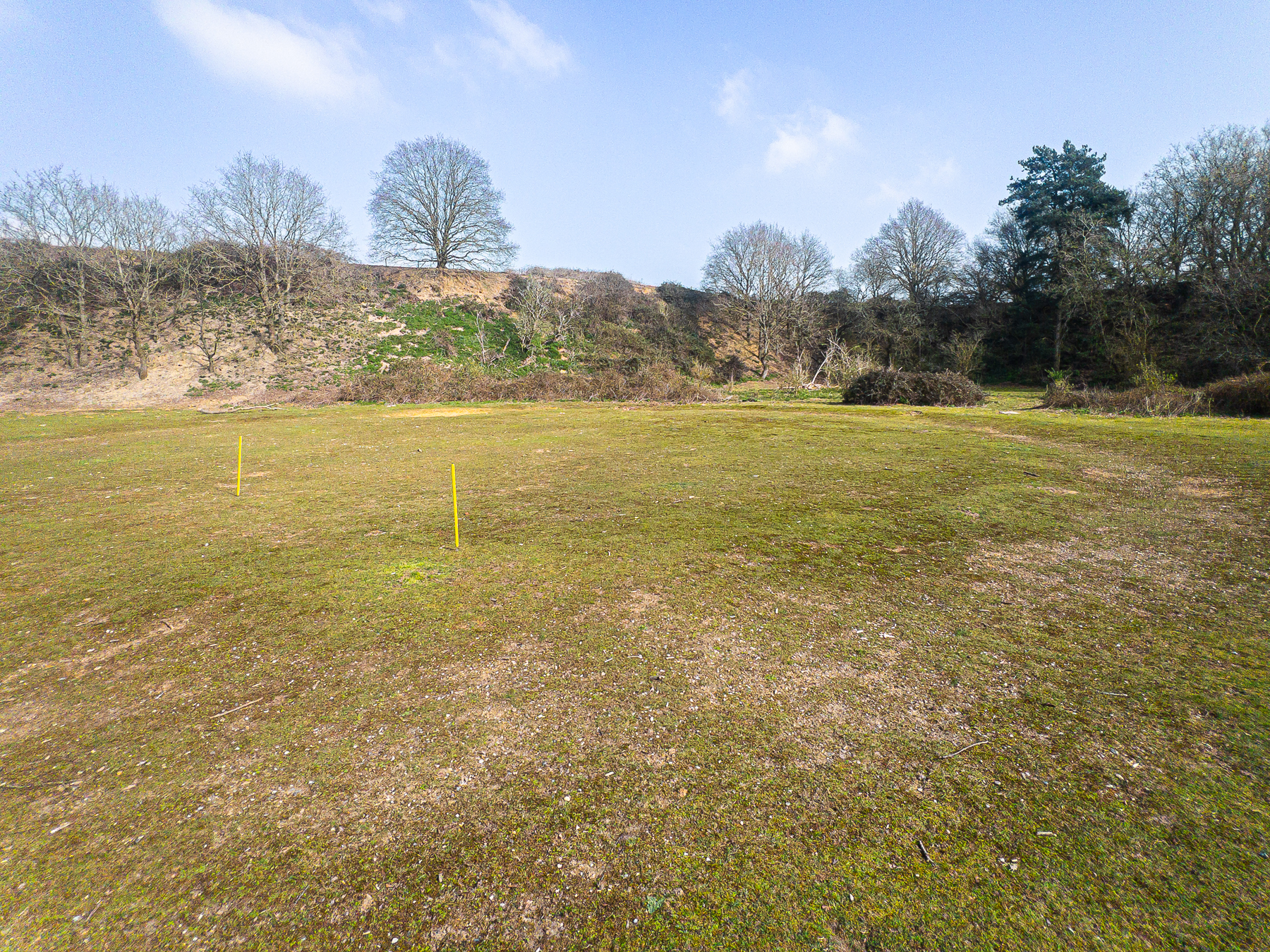
This past weekend, I spent a half-day surveying Holton Pits, a former gravel quarry near the village of Holton. Formerly owned by the aggregates company CEMEX, the quarry has not been exploited since the early 1970s, and it has been left to its natural course since then. Part of the site was designated in 1988 as a Site of Special Scientific Interest for its geological features, and the whole site was designated in 1991 as a County Wildlife Site.
In the five decades since its last commercial use, Holton Pits have also become an environmental and recreational asset for local villagers. In 2023, they banded together in a trust to purchase it for the community. At that time, Rachel Kellett, one of the original trustees and owner of a nearby woodland called Kaliwood, invited me to explore the site for lichens. I regret that it’s taken me so long!
I arrived hoping to find abundant Cladonia species in the acid grassland portions of the site, as photographs from the time of purchase seemed to show. However, it appears that more intensive community use has been challenging for these ground-dwelling lichens, which are vulnerable to trampling.
What I was not prepared to find on an oak tree was this:
- Anaptychia ciliaris — an endangered lichen once widespread in England, but which hasn’t been recorded in Suffolk since 1985, and which was assumed to be extinct in the county!
This extraordinary find deserves its own post, which I’ll publish very soon.
In the meanwhile, the full list of taxa recorded from Holton Pits, including both lichens and lichenicolous fungi (LFs), is as follows:
Holton : Holton Pit CWS & SSSI : VC25 East Suffolk : TM4077 : 22 March 2026
- Anaptychia ciliaris
- Anisomeridium biforme
- Arthonia radiata
- Candelaria concolor
- Cetraria aculeata
- Cladonia chlorophaea s. lat.
- Cladonia fimbriata
- Cladonia furcata subsp. furcata
- Cladonia rangiformis
- Cladonia squamosa var. squamosa
- Diploicia canescens
- Erythricium aurantiacum (Marchandiomyces aurantiacus) [LF]
- Evernia prunastri
- Flavoparmelia soredians
- Glaucomaria (Lecanora) carpinea
- Hypotrachyna revoluta s. str.
- Lecanora barkmaniana
- Lecanora hybocarpa auct. br.
- Lecidella elaeochroma f. elaeochroma
- Lepraria finkii (lobificans)
- Lepraria incana s. str.
- Melanelixia subaurifera
- Parmelia sulcata
- Parmotrema perlatum
- Phaeophyscia orbicularis
- Phlyctis argena
- Physcia adscendens
- Physcia tenella
- Physconia grisea
- Punctelia jeckeri
- Punctelia subrudecta s. str.
- Ramalina farinacea
- Ramalina fastigiata
- Unguiculariopsis thallophila [LF]
- Xanthoria parietina
- Zeora (Lecanora) expallens
- Zeora (Lecanora) symmicta
