
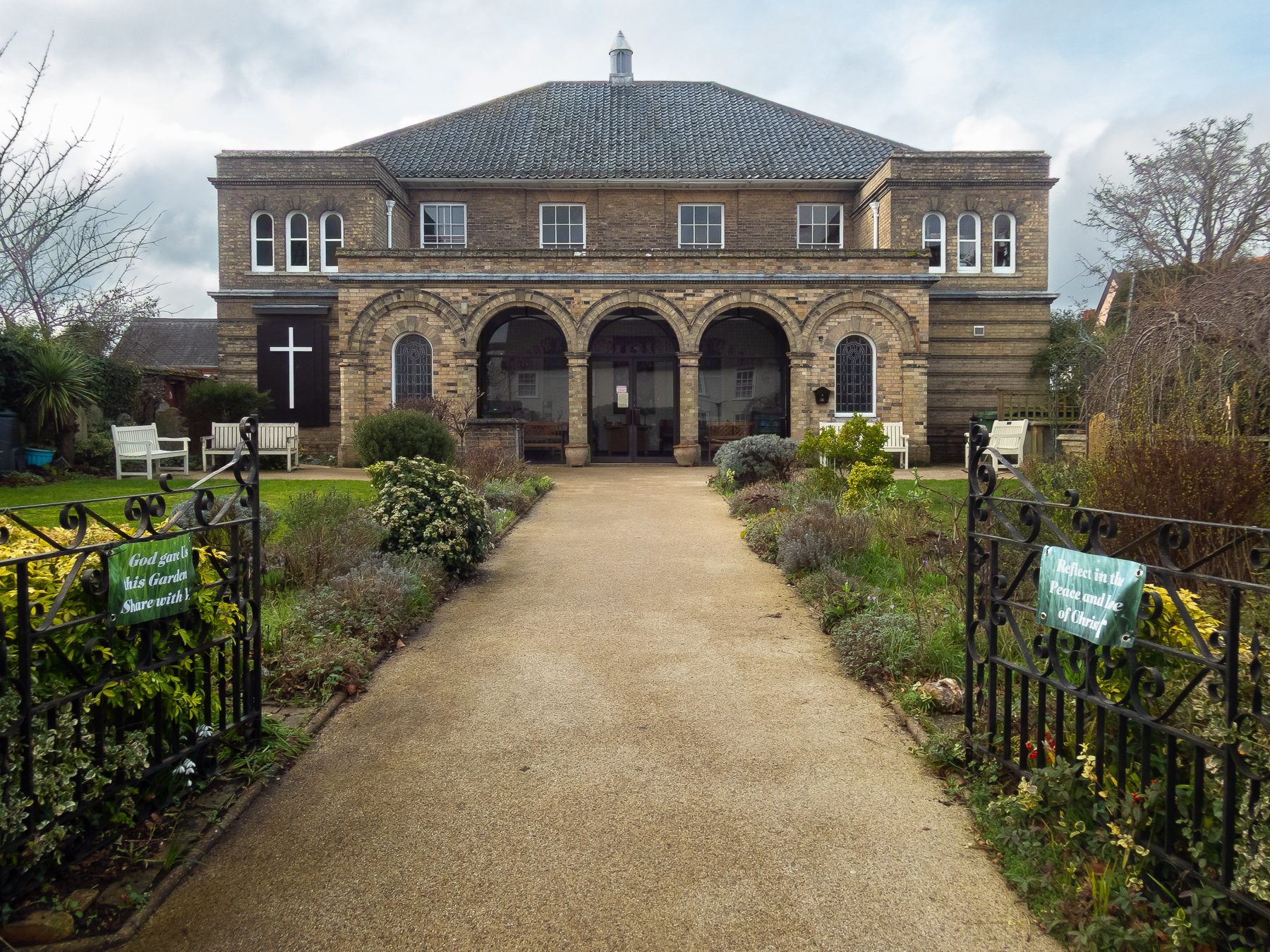
Having surveyed St Edmund’s Church in Bungay in January, the following month I turned to the fifth and final churchyard or cemetery in the town that had not previously been surveyed. Emmanuel Church is Bungay’s chapel for the Methodist and United Reformed communities. It is a handsome church originally built in 1858, replacing an earlier congregational chapel dating back to the late 18th century.
Sadly, some time ago all of the gravestones in the churchyard were removed to create an open garden, and leaned against the boundary walls. They’re now shaded, algae-covered, and devoid of the lichens that must have once flourished on them. The clearing of the churchyard potentially destroyed up to a third of the lichen biodiversity at Emmanuel: I recorded only about two dozen species there, compared with the three-or-so dozen at St Edmund’s, a church of similar age and churchyard size.
Fortunately, some heavy chest-tombs remained in situ to host lichens, and even the large terracotta plant pots flanking the front doors provided one of local interest:
- Lecania inundata — a ‘nationally scarce’ species (but most likely just under-recorded, as it belongs to the confusing ‘Lecania erysibe s. lat.’ group of lichens normally recorded pragmatically in aggregate)
The full list of species recorded from St Edmund’s Church is as follows:
Bungay : Emmanuel Church : VC25 East Suffolk : TM3389 : 8 February 2026
- Bagliettoa parmigera s. lat. (Verrucaria baldensis s. lat.)
- Botryolepraria lesdainii
- Candelariella aurella f. aurella
- Candelariella vitellina f. vitellina
- Catillaria lenticularis
- Circinaria (Aspicilia) contorta
- Diplotomma alboatrum
- Flavoplaca (Caloplaca) citrina s. str.
- Flavoplaca (Caloplaca) flavocitrina
- Flavoplaca (Caloplaca) oasis
- Hyperphyscia adglutinata
- Lecania inundata
- Lecanora campestris subsp. campestris
- Lecidella scabra
- Lecidella stigmatea
- Myriolecis (Lecanora) albescens
- Myriolecis (Lecanora) dispersa
- Physcia adscendens
- Physcia tenella
- Porpidia soredizodes
- Protoblastenia rupestris
- Rinodina oleae
- Variospora (Caloplaca) flavescens
- Verrucaria macrostoma f. macrostoma
- Verrucaria nigrescens f. nigrescens
- Xanthoria parietina

