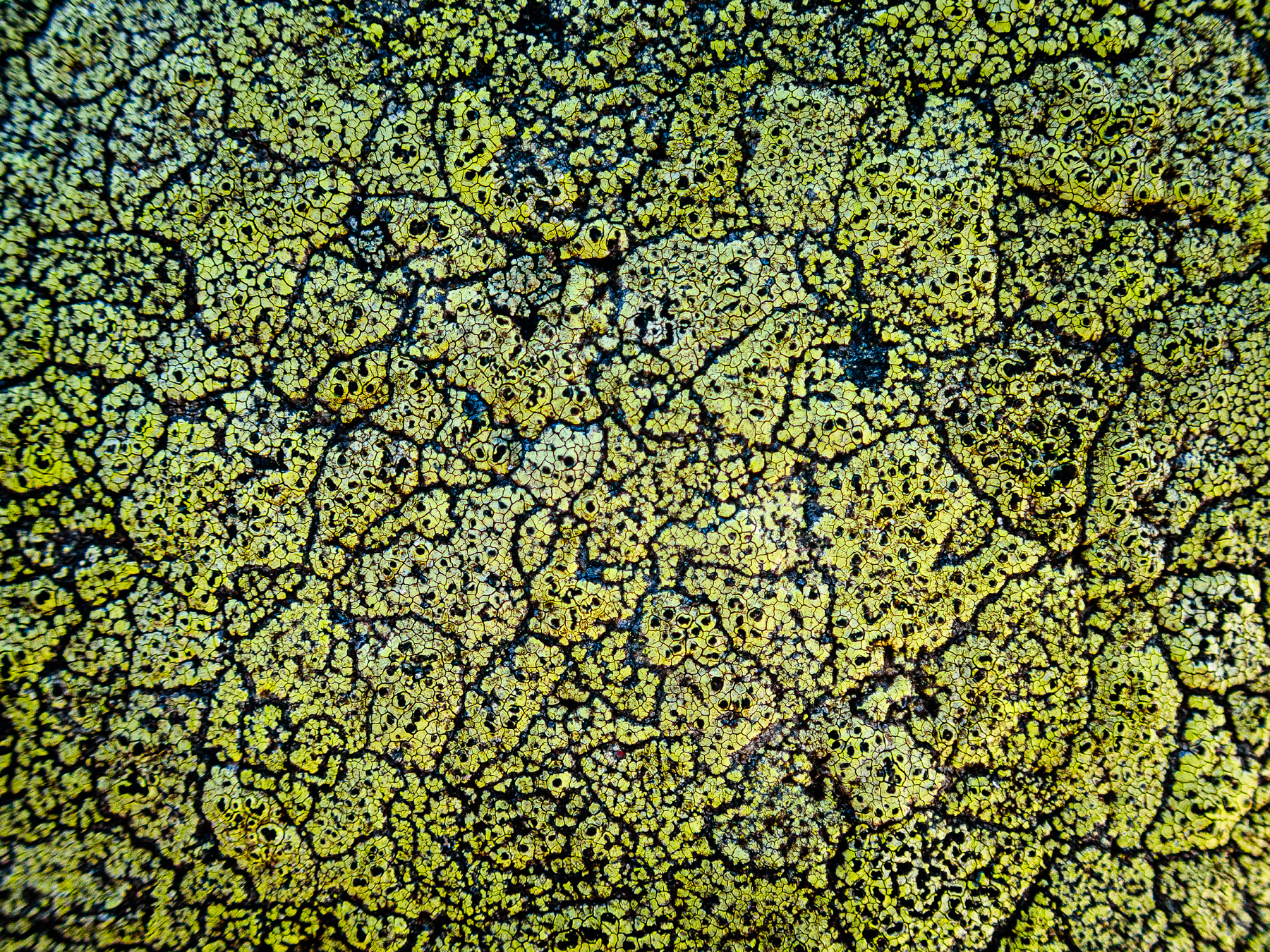
| TAXON: | Rhizocarpon geographicum (L.) DC. (1805) |
| RECENT SYNONYMS: | – |
| FAMILY: | Rhizocarpaceae |
| GROWTH FORM: | Crustose, heteromerous |
| SUBSTRATES: | Siliceous rocks and worked stone, walls, roof tiles, monuments, etc |
| PHOTOBIONT: | Chlorococcoid alga |
| REPRODUCTION: | Apothecia |
| ASCUS: | Clavate to cylindrical; apex Rhizocarpon-type; 8 spores |
| SPORES: | Ascospores muriform, 5-22 cells in optical section, dark brown, 20-50 × 10-20 µm |
| NOTABLE FEATURES: | Thallus pale to vivid green-yellow, with well-defined, angular areoles; prothallus black, visible between areoles; apothecia lecideine, flat to slightly convex, arising between areoles; discs black |
| CHEMICAL TESTS: | Medulla Pd± yellow (rhizocarpic acid, and either psoromic or barbatic acid) |
| HABITAT: | In sunny situations with suitable substrate, from sea-level to mountains |
| DISTRIBUTION: | Widespread and common in northern and western Britain; rare in southeast England |
| CONSERVATION STATUS: | Least Concern |
| LICHENICOLOUS FUNGI: | Endococcus macrosporus, E. perpusillus, Muellerella pygmaea |
| IDENTIFICATION DIFFICULTY: | Green 1: Field identification possible |
| CONFUSION SPECIES: | Rhizocarpon lecanorinum |
FIELD NOTES
To be added.
LAB NOTES
Rhizocarpon geographicum can be identified without microscopy.
SPECIMENS
Rhizocarpon geographicum : Scotland : VC101 Kintyre : TF7372 : August 2023 : On siliceous boulders : © Anthony Speca : CC BY-SA 4.0


Rhizocarpon geographicum : Scotland : VC101 Kintyre : TF7074 : July 2023 : On siliceous outcrop: © Anthony Speca : CC BY-SA 4.0

Rhizocarpon geographicum : Scotland : VC101 Kintyre : NR6974 : July 2022 : On siliceous outcrops : © Anthony Speca : CC BY-SA 4.0


