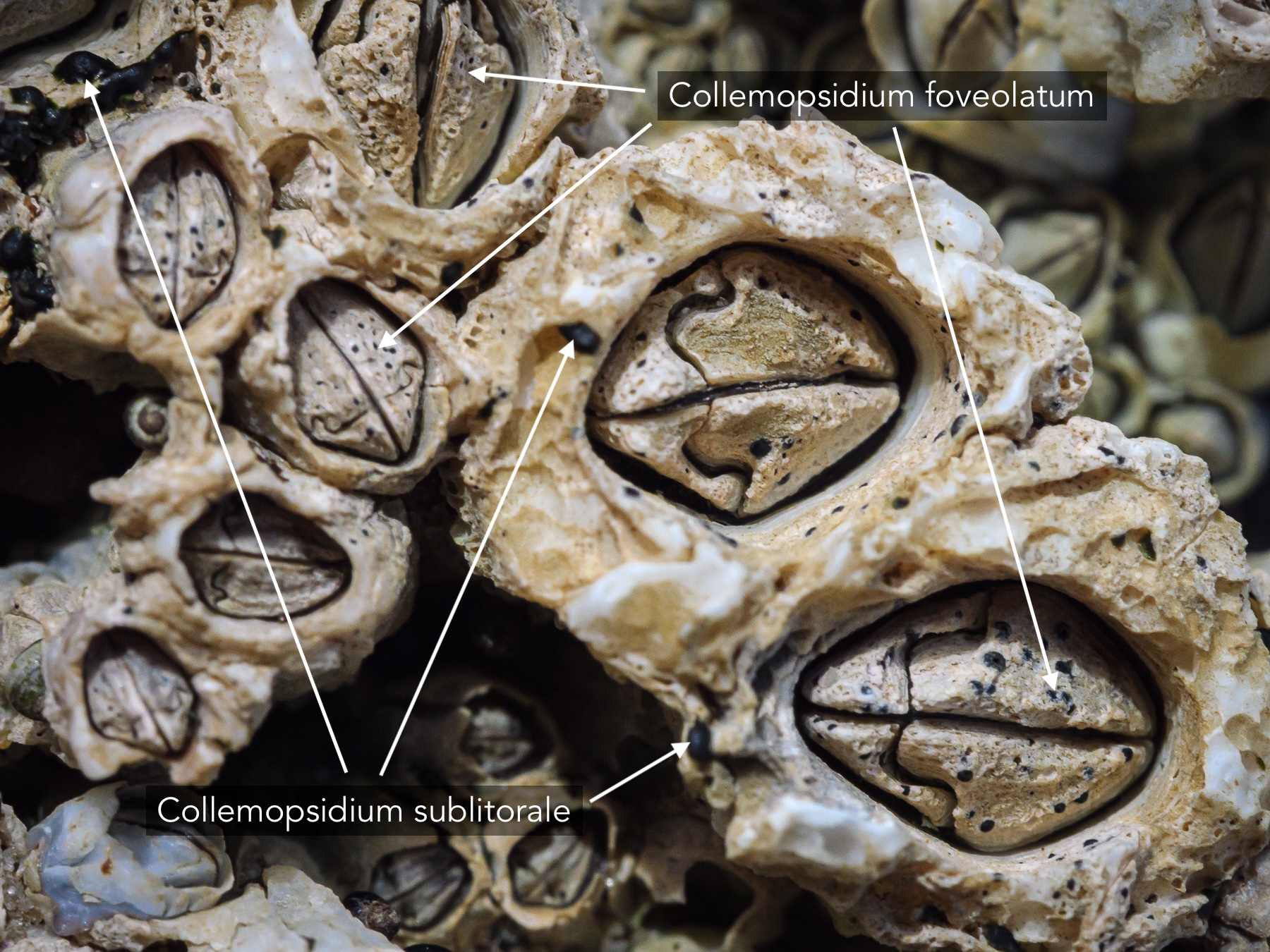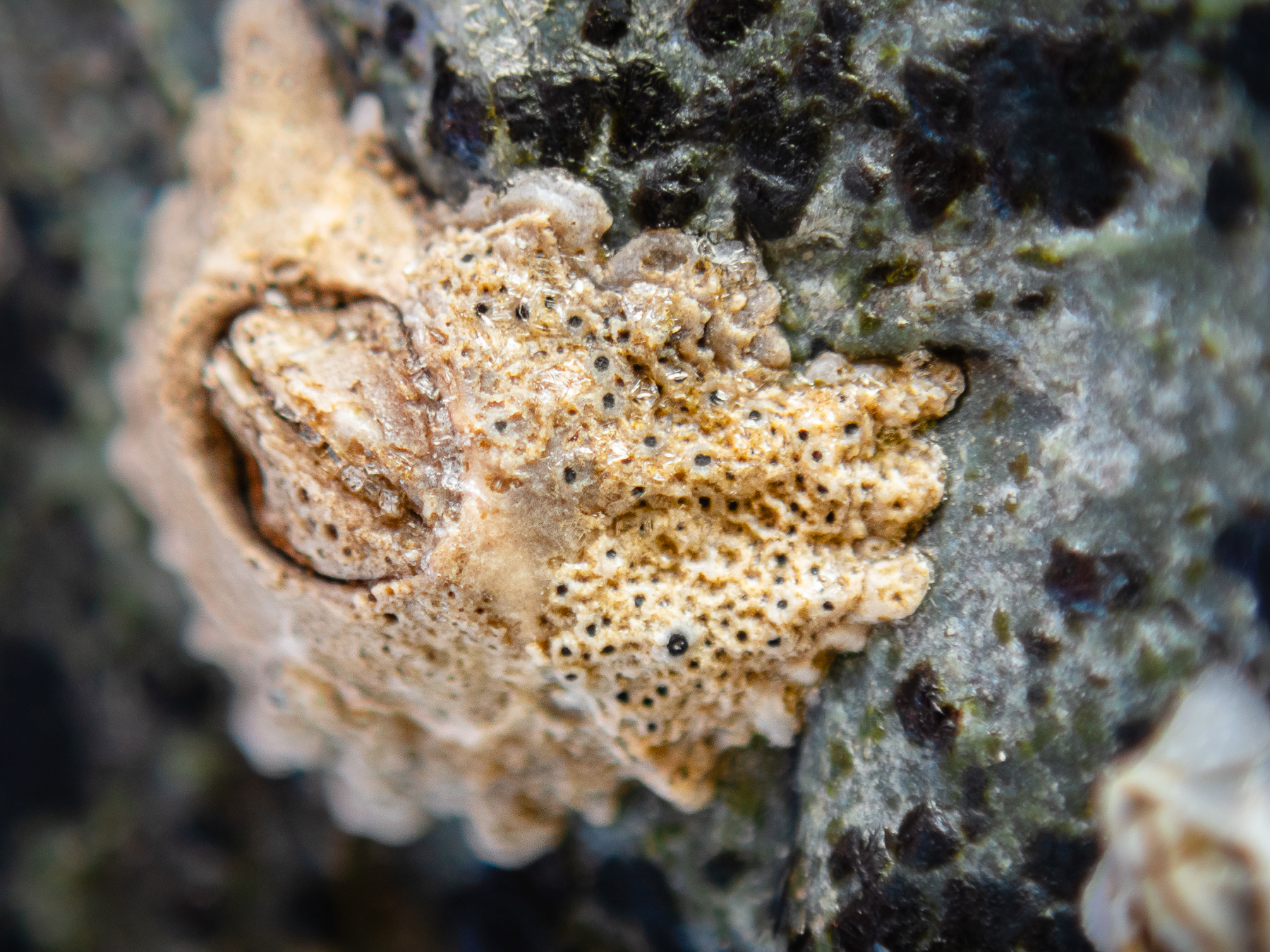
| TAXON: | Collemopsidium foveolatum (A.L. Sm.) F. Mohr (2004) |
| RECENT SYNONYMS: | – |
| FAMILY: | Xanthopyreniaceae |
| GROWTH FORM: | Crustose, heteromerous |
| SUBSTRATES: | Shells of barnacles or marine molluscs, or calcareous rock |
| PHOTOBIONT: | Hyella cyanobacterium |
| REPRODUCTION: | Perithecia, pycnidia |
| ASCUS: | Ovoid to subcylindrical, usually stalked; apex K/I- with thickened wall and ocular chamber; 8 spores |
| SPORES: | Ascospores ovoid to cylindrical-fusiform, 1-septate with upper cell usually wider, 17-26 x 6-12 µm; conidia bacilliform to ellipsoidal |
| NOTABLE FEATURES: | Thallus immersed in substrate; perithecia small, black, fully contained in pits or occasionally slightly emergent; involucrellum flat and reminiscent of lid, or occasionally slightly convex, sometimes absent |
| CHEMICAL TESTS: | – |
| HABITAT: | Maritime shores from supralittoral to intertidal zones |
| DISTRIBUTION: | All around British coasts |
| CONSERVATION STATUS: | Least Concern |
| LICHENICOLOUS FUNGI: | – |
| IDENTIFICATION DIFFICULTY: | Green 2: Field identification possible with care |
| CONFUSION SPECIES: | Collemopsidium ostrearum, C. sublitorale |
FIELD NOTES
To be added.
LAB NOTES
Collemopsidium foveolatum can be identified without microscopy.
SPECIMENS
Collemopsidium foveolatum : Wales : VC52 Anglesey : SH3493 : April 2026 : On Cirripedia shell : © Anthony Speca : CC BY-SA 4.0

Collemopsidium foveolatum : Scotland : VC101 Kintyre : NR7372 : August 2022 : On Cirripedia shell : © Anthony Speca : CC BY-SA 4.0