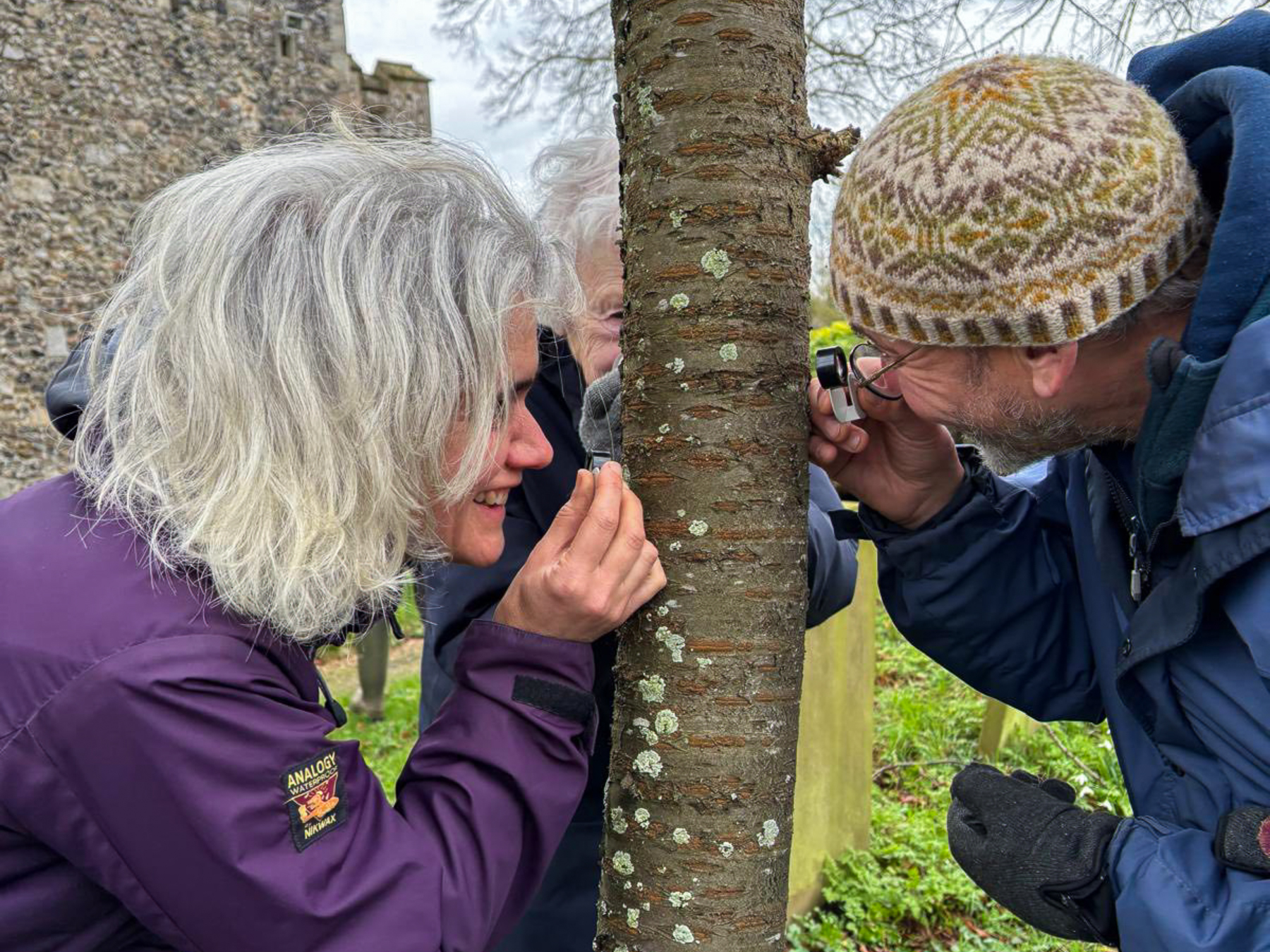
Lichen training for Bungay Conservation Volunteers
Image courtesy of Gill Hirst, Bungay Conservation Volunteers
The town of Bungay, which sits on the River Waveney at the edge of the Broads National Park, is lucky to have its own local conservation group affiliated with The Conservation Volunteers, a national charity connecting local communities with their local environment.
Bungay Conservation Volunteers (BCV) undertake a lot of work to help maintain and improve green spaces in the town, including Bungay’s churchyards. And churchyards, including civic cemeteries, are one of the most important lichen habitats in the UK, especially in East Anglia where there are no natural stone outcrops.
So I was delighted when BCV asked me to train up their group on lichens!
We dedicated a cold but pleasant half-day to understanding lichens, discussing proper churchyard lichen management, and walking through Bungay’s churchyards to observe lichens and consider how BCV could help conserve and promote them.
It was a privilege to bring this hidden world into focus for the BCV volunteers:
Thank you so very much for today. You have opened up a whole new area of interest, thank you.
All best to the BCV in their work to enhance Bungay’s ecology and biodiversity!
Anthony is the field lichenologist behind Aspen Ecology. A committed naturalist, educator and communicator, he is a knowledgeable guide and responsive advisor on the remarkable world of lichens.
The field notes and lab notes for various lichen species on this website refer to special field-lichenological techniques. Examples include collecting lichens in the field, testing lichens with chemicals and ultraviolet light, and dissecting lichens with razors or other sharp tools.
These and other field-lichenological techniques require special knowledge and experience. They also demand an ethics of respect for lichens and other wildlife, for conservationally significant species and sites, and for land and landowners.
You should not attempt any of these techniques if you lack the necessary knowledge, experience or ethical sense. You should also take all relevant safety precautions. More information about field-lichenological safety and ethics is available from the British Lichen Society .